
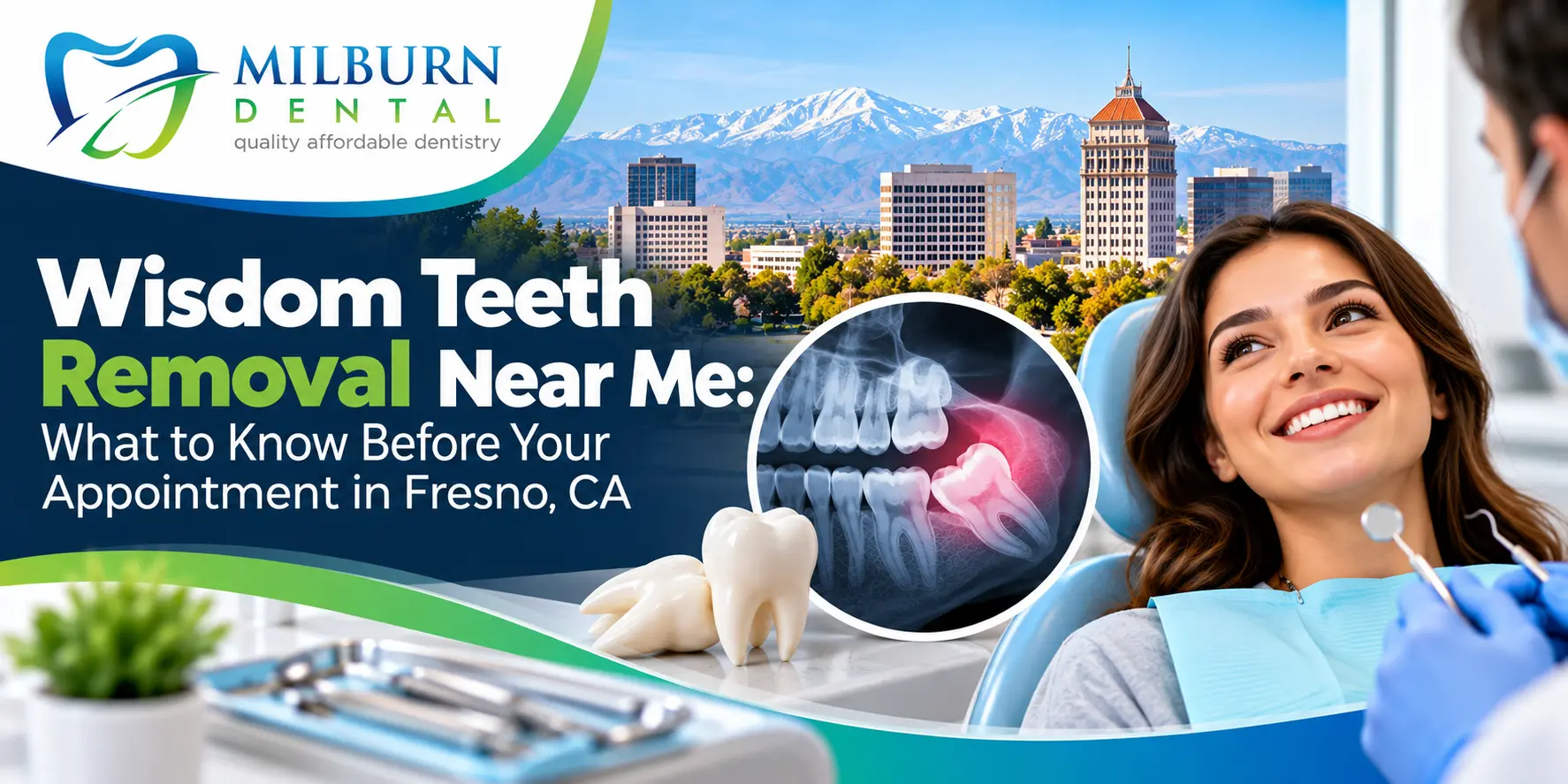
Wisdom Teeth Removal Near Me: What to Know Before Your Appointment in Fresno, CA
If you are searching for wisdom teeth removal near me, you may be experiencing pain at the back of your mouth, swollen gums, jaw discomfort, or concerns about a wisdom tooth that is growing in the wrong direction. Even if you do not have symptoms, you may wonder whether your wisdom teeth need to be removed to protect your long-term oral health.
Wisdom teeth are the last molars to develop, usually appearing during the late teenage years or early adulthood. For some people, these teeth emerge normally and do not cause problems. For others, limited space in the jaw can prevent a wisdom tooth from fully erupting, allowing it to become impacted or contribute to pain, infection, and other dental concerns.
If you live in Fresno, California, understanding when wisdom teeth removal in Fresno may be necessary can help you make informed decisions about your dental care.
At Milburn Dental, patients can explore oral surgery and tooth extraction options following an appropriate dental evaluation. This guide explains common wisdom tooth symptoms, when extraction may be recommended, what to expect during treatment, how to recover, and what to consider when choosing a local dental provider.
What Are Wisdom Teeth?
Wisdom teeth are the third molars located at the very back of the mouth. Most people have up to four wisdom teeth, although some develop fewer or none at all.
These teeth usually emerge between the ages of 17 and 25, but the timing varies from person to person. Some wisdom teeth erupt fully through the gums, while others remain partially or completely beneath the gum tissue.
When the jaw has enough room and the teeth grow into a healthy position, wisdom teeth may not require removal. However, problems can develop when there is insufficient space for them to emerge properly.
A wisdom tooth may grow at an angle, press against an adjacent tooth, remain trapped under the gums, or become difficult to clean. These situations can increase the risk of inflammation, decay, gum problems, and other complications.
Not every wisdom tooth needs to be extracted. A dental examination and appropriate imaging can help determine whether your wisdom teeth should be monitored or removed.
If you are looking for wisdom teeth removal near me in Fresno, CA, the first step is to have your symptoms and the position of your wisdom teeth evaluated by a dental professional.
Signs You May Need Wisdom Teeth Removal
Wisdom tooth problems can develop gradually or appear suddenly. Recognizing the warning signs can help you determine when to schedule an evaluation.
1. Pain at the Back of Your Mouth
Pain near your back molars is one of the most common reasons people seek wisdom tooth evaluation.
The discomfort may feel like pressure, tenderness, or a dull ache behind your other teeth. It may come and go or become more noticeable when chewing.
Pain does not automatically mean a wisdom tooth needs to be removed. Cavities, gum inflammation, cracked teeth, and other dental conditions can cause similar symptoms.
A dentist can examine the area and help identify the cause.
2. Swollen or Tender Gums
When a wisdom tooth partially emerges, a flap of gum tissue may remain over part of the tooth. Food particles and bacteria can collect beneath this tissue, causing inflammation and sometimes an infection known as pericoronitis.
Possible symptoms include:
- Redness or swelling around the back molars.
- Tenderness when brushing or chewing.
- An unpleasant taste or persistent bad breath.
- Discomfort when opening your mouth.
- Swelling that returns after temporarily improving.
Recurring inflammation around a partially erupted wisdom tooth should be evaluated rather than repeatedly managed at home.
3. Jaw Pain or Stiffness
An impacted wisdom tooth or inflammation around the surrounding tissues may contribute to discomfort in the back of the jaw.
You might notice soreness when opening your mouth, chewing, or moving your jaw.
However, jaw pain can also result from teeth grinding, muscle tension, or temporomandibular joint problems. A dental examination helps distinguish between these possibilities.
4. Food Getting Trapped Around a Wisdom Tooth
Partially erupted wisdom teeth can create spaces that are difficult to clean effectively.
Food and plaque may accumulate around the tooth, increasing the risk of gum inflammation and decay. The adjacent second molar may also become vulnerable to cavities or damage.
If you frequently struggle to keep the area clean, ask your dentist whether the tooth’s position creates a long-term problem.
5. Repeated Infections or Swelling
Repeated episodes of gum inflammation around the same wisdom tooth may indicate that the underlying issue has not been resolved.
Your dentist may recommend treatment based on the severity and frequency of the episodes, the tooth’s position, and your overall oral health.
If you have facial swelling, fever, pus, or worsening pain, seek prompt dental care. If swelling affects breathing or swallowing, seek emergency medical attention.
Do All Wisdom Teeth Need to Be Removed?
No. Wisdom tooth removal is not automatically necessary for every patient.
Some wisdom teeth erupt normally, remain functional, and can be cleaned effectively. When these teeth are healthy and do not threaten surrounding structures, a dentist may recommend monitoring them during regular examinations.
Removal may be considered when a wisdom tooth:
- Is impacted or growing at an unfavorable angle.
- Causes repeated gum infections.
- Has significant decay that cannot be treated predictably.
- Contributes to damage or decay in the neighboring molar.
- Is associated with certain cysts or other abnormalities.
- Cannot be maintained adequately because of its position.
The decision should be based on an individual assessment rather than age alone.
Your dentist may recommend periodic examinations and X-rays to monitor wisdom teeth that are not currently causing problems. If a concern develops, the treatment plan can be reviewed.
Learn more about oral surgery and tooth extraction at Milburn Dental to understand how dental professionals evaluate impacted or problematic teeth and determine an appropriate course of treatment.
What Is an Impacted Wisdom Tooth?
An impacted wisdom tooth is a tooth that cannot fully emerge into its expected position in the mouth.
Impaction can happen when there is insufficient space in the jaw or when the tooth develops at an unfavorable angle.
There are several common forms of impaction.
Soft Tissue Impaction
The crown of the tooth may emerge partly through the gums while some of the tooth remains covered by soft tissue. This can create an area where food and bacteria become trapped.
Partial Bony Impaction
Part of the tooth remains covered by gum tissue and jawbone. The tooth may emerge only partially, depending on its position.
Complete Bony Impaction
The tooth remains entirely beneath the gum tissue and jawbone. It may not be visible during a routine visual examination.
The position and depth of an impacted wisdom tooth affect how it is evaluated and whether a surgical extraction may be necessary.
Dental X-rays can help show the tooth’s position and its relationship to nearby teeth and surrounding structures. Your dentist can use this information to explain the potential benefits, risks, and complexity of treatment.
What Happens During a Wisdom Teeth Removal Consultation?
If you are searching for wisdom teeth removal near me, understanding the consultation process can make your first appointment less stressful.
Step 1: Discuss Your Symptoms and Medical History
Your dentist will ask about your symptoms, when they began, and whether you have experienced swelling, pain, infection, or difficulty chewing.
You should also provide information about your medical history, medications, allergies, and previous dental procedures. These details can influence treatment planning and the precautions needed before an extraction.
Tell your dental team if you have experienced dental anxiety or had difficulty with previous dental procedures.
Step 2: Examine Your Teeth and Gums
The dentist will examine the area around your wisdom teeth, looking for swelling, tenderness, decay, gum inflammation, and other signs of a problem.
The examination may also include checking the neighboring molars because wisdom teeth can affect the health of adjacent teeth.
Step 3: Take Dental X-Rays When Appropriate
Imaging can help determine whether a wisdom tooth is fully erupted, partially impacted, or positioned beneath the gums.
X-rays may also reveal the tooth’s angle and relationship to nearby anatomical structures. Additional imaging may be recommended in selected cases if the dentist needs more information for treatment planning.
Learn more about dental X-rays and diagnostic imaging at Milburn Dental to understand how imaging can support dental evaluation.
Step 4: Discuss Your Treatment Options
Based on the examination, your dentist can explain whether monitoring, treating an existing problem, or removing the wisdom tooth may be appropriate.
If extraction is recommended, ask about the type of procedure, anesthesia or comfort options, expected recovery, possible complications, and whether referral to an oral surgeon is advisable.
Not every wisdom tooth can or should be removed using the same approach. Your treatment plan should reflect your individual anatomy and dental needs.
Simple Extraction vs. Surgical Wisdom Tooth Removal
The type of extraction depends primarily on how the tooth is positioned and how accessible it is.
Simple Tooth Extraction
A simple extraction may be possible when a tooth has erupted sufficiently and can be accessed without removing significant amounts of surrounding bone.
The dentist uses appropriate instruments and anesthesia to remove the tooth while protecting the surrounding tissues.
Surgical Extraction
A surgical extraction may be needed when a wisdom tooth is impacted, partially trapped beneath the gums, or difficult to access.
Depending on the tooth’s position, the procedure may involve an incision in the gum tissue, removal of a limited amount of bone, or dividing the tooth into smaller sections to facilitate removal. Stitches may be used when appropriate.
Surgical extraction is not necessarily required for every wisdom tooth. The dentist determines the appropriate method after examining the tooth and reviewing the available imaging.
Milburn Dental provides oral surgery and tooth extraction services in Fresno. For complex impactions or cases requiring specialist care, your dentist can discuss whether referral to an oral surgeon is appropriate.
Does Wisdom Teeth Removal Hurt?
It is normal to feel nervous about having a wisdom tooth removed, especially if you have never undergone an extraction.
During the procedure, local anesthesia is commonly used to numb the treatment area. You may feel pressure or movement, but you should communicate with your dental team if you experience pain.
Depending on the complexity of the procedure and your individual circumstances, additional comfort or sedation options may be discussed. Not every patient is a candidate for every sedation method, so a medical history review is important.
After the anesthesia wears off, you may experience soreness, swelling, bruising, or jaw stiffness. The severity and duration depend on the number of teeth removed, the difficulty of the extraction, and your individual healing response.
Your dental team will provide instructions about managing discomfort and protecting the extraction site.
If fear or anxiety has caused you to postpone treatment, discuss your concerns before the procedure. Knowing what to expect and having a clear treatment plan can make the experience more manageable.
How Long Does Wisdom Teeth Removal Take?
The duration varies according to the tooth’s position, the complexity of the extraction, and whether one or multiple wisdom teeth are being removed.
A straightforward extraction may take less time than a surgical procedure involving an impacted tooth. The overall appointment may also include preparation, anesthesia, and post-procedure instructions.
During your consultation, ask how long you should plan to be at the dental office and whether you will need someone to accompany you or drive you home.
If sedation is planned, follow all instructions regarding eating, drinking, transportation, and post-procedure supervision.
Wisdom Teeth Removal Recovery: What to Expect
Recovery is an important part of successful wisdom tooth treatment. Mild discomfort and swelling are common, particularly during the first few days.
Your dentist will provide instructions based on the procedure performed and your medical history.
The First 24 Hours
A blood clot forms in the extraction socket and helps protect the underlying tissues during healing.
To avoid disturbing the clot:
- Follow the instructions provided for controlling bleeding.
- Avoid vigorous rinsing, forceful spitting, and unnecessary touching of the socket.
- Do not use a straw unless your dentist specifically advises otherwise.
- Avoid smoking and vaping during healing.
- Rest and avoid strenuous activity as instructed.
- Use prescribed or recommended medication only as directed.
If you are given gauze, use it according to your dentist’s instructions. Contact the office if bleeding is heavy or does not improve with the recommended measures.
Days Two and Three
Some swelling, bruising, and jaw stiffness may continue during the first few days. Symptoms should generally begin to improve rather than progressively worsen.
Use a cold compress if recommended, and follow the instructions provided for pain management and oral hygiene.
Choose soft foods that require minimal chewing, such as yogurt, scrambled eggs, mashed potatoes, and cooled or lukewarm soups. Avoid foods that are hard, crunchy, very hot, or likely to become trapped in the socket.
The First Week
Continue keeping your mouth clean while protecting the surgical site.
Your dentist may recommend gentle saltwater rinses after the first 24 hours, depending on the procedure and your circumstances. Brush your other teeth carefully and avoid traumatizing the extraction area.
Gradually return to your normal diet and activities as your comfort improves and your dentist advises.
Many patients feel substantially better within several days, but healing varies. More complex surgical extractions may require a longer recovery period, and the socket can take several weeks to heal fully.
When Should You Contact Your Dentist?
Contact your dentist promptly if you experience:
- Severe pain that does not improve with recommended medication.
- Swelling that worsens after the first few days.
- Persistent or heavy bleeding.
- Fever or signs of infection.
- Pus or a persistent unpleasant taste associated with the extraction site.
- New or persistent numbness.
Difficulty breathing or swallowing, or rapidly spreading facial or neck swelling, requires emergency medical attention.
What Is Dry Socket After Wisdom Tooth Extraction?
Dry socket is a painful complication that can occur when the blood clot protecting the extraction socket is lost or breaks down prematurely.
It often causes increasing pain a few days after the extraction. The pain may radiate toward the ear or other parts of the jaw and may be accompanied by an unpleasant taste or odor.
Dry socket is not the same as every instance of post-extraction soreness. Your dentist can examine the area and determine the cause of your symptoms.
To help reduce the risk, follow all aftercare instructions carefully. Avoid smoking, using straws, vigorous rinsing, and forceful spitting during the period recommended by your dental team.
If you suspect dry socket, contact your dentist rather than trying to treat the socket yourself. Professional care can help manage the discomfort and support healing.
How Much Does Wisdom Teeth Removal Cost in Fresno, CA?
The cost of wisdom teeth removal varies from patient to patient. Factors may include:
- Whether the tooth has fully erupted or is impacted.
- Whether a simple or surgical extraction is required.
- The number of teeth being removed.
- The type of anesthesia or sedation used.
- The need for additional imaging or specialist care.
- Your dental insurance coverage and plan benefits.
A straightforward extraction generally involves different considerations from a complex surgical procedure.
When contacting a dental office, ask whether the initial examination and imaging are included in the estimate, whether additional treatment may be needed, and what your insurance may cover.
If you have dental insurance, provide your plan information before treatment so the office can help clarify applicable benefits. Coverage and out-of-pocket expenses depend on your individual policy.
For accurate pricing, request an evaluation and a treatment estimate based on your specific situation rather than relying solely on a general online price range.
How to Choose Wisdom Teeth Removal Near Me in Fresno
Finding a nearby dental office is important, but there are other factors to consider when choosing where to receive treatment.
Look for a Thorough Evaluation
A good treatment plan should be based on your symptoms, oral examination, and appropriate diagnostic imaging. You should understand why removal is being recommended and whether other options are reasonable.
Ask About the Procedure and Recovery
Before treatment, make sure you understand the planned extraction method, anesthesia options, aftercare instructions, and potential complications.
You should also know whom to contact if you have concerns during recovery.
Consider Access to Related Dental Care
Wisdom tooth problems may occur alongside other dental issues, such as decay in neighboring molars or gum inflammation.
Choosing a dental office that can evaluate your broader oral health may help you understand the complete picture and plan any additional treatment when necessary.
Milburn Dental offers general dentistry, oral surgery, and other dental services in Fresno. You can explore the practice’s complete list of dental services to learn more about available care.
Choose a Convenient Location
Milburn Dental is located at:
Milburn Dental
6721 N Milburn Ave, Suite 101
Fresno, CA 93722
Phone: (559) 825-0990
If you are searching for wisdom teeth removal near you in Fresno, contact the office to discuss your symptoms, ask about an evaluation, and learn whether your needs can be managed at the practice or require a specialist referral.
Frequently Asked Questions About Wisdom Teeth Removal Near Me
1. Where can I find wisdom teeth removal near me in Fresno, CA?
Milburn Dental provides oral surgery and tooth extraction services in Fresno, including evaluation of impacted or problematic teeth. The office is located at 6721 N Milburn Ave, Suite 101, Fresno, CA 93722. Call (559) 825-0990 to discuss your needs and available appointment options.
2. How do I know if my wisdom teeth need to be removed?
Common reasons for evaluation include pain, swollen gums, repeated inflammation, decay, impaction, or damage to neighboring teeth. Some wisdom teeth do not need removal. A dental examination and appropriate imaging can help determine the best approach.
3. Can wisdom teeth be removed if they are impacted?
Yes, impacted wisdom teeth can often be removed when treatment is indicated. The procedure may be more complex if the tooth is beneath the gums or jawbone. Your dentist can assess the position of the tooth and determine whether extraction at the office or referral to an oral surgeon is appropriate.
4. How many days does it take to recover from wisdom teeth removal?
Many patients experience their most noticeable discomfort during the first few days and gradually improve over the following week. More complex procedures may require additional recovery time, and complete healing takes longer. Follow your dentist’s instructions and contact the office if symptoms worsen.
5. Can I eat normally after wisdom teeth removal?
You will usually need to eat soft foods initially and gradually return to your usual diet as healing progresses. Avoid hard, crunchy, or irritating foods that may disturb the extraction site. Your dentist will provide recommendations tailored to your procedure.
6. What should I do if my wisdom tooth suddenly becomes painful?
Contact a dentist for an evaluation, especially if the pain is severe, persistent, or accompanied by swelling or fever. If you experience difficulty breathing or swallowing, seek emergency medical attention.
7. Is wisdom teeth removal covered by dental insurance?
Coverage varies by policy and may depend on whether the extraction is medically necessary, the procedure type, and your plan’s benefits. Ask your insurer and dental office to clarify coverage and estimated out-of-pocket costs before treatment.
8. Can I wait to remove a wisdom tooth if it does not hurt?
Sometimes. Healthy wisdom teeth that are properly positioned and easy to clean may be monitored. However, the absence of pain does not always mean a tooth is problem-free. Regular examinations help identify potential issues and determine whether monitoring or removal is appropriate.
Schedule a Wisdom Teeth Evaluation at Milburn Dental
If you have been searching for wisdom teeth removal near me, the next step is to understand what is happening in your mouth and whether treatment is necessary.
Wisdom teeth do not always require extraction, but impacted teeth, recurring gum infections, decay, and damage to neighboring molars may make removal an appropriate option. A professional evaluation can help you understand the benefits, risks, expected recovery, and treatment choices available to you.
Milburn Dental offers oral surgery and tooth extraction services in Fresno, California. Our dental team can evaluate your concerns, explain appropriate next steps, and discuss whether treatment at the practice or referral to an oral surgeon is best for your needs.
Contact Milburn Dental
- Address: 6721 N Milburn Ave, Suite 101, Fresno, CA 93722
- Phone: (559) 825-0990
- Website: Milburn Dental
Call to ask about scheduling a dental evaluation and discussing your wisdom teeth concerns.
Getting the right information early can help you protect your oral health and make a more confident decision about wisdom teeth treatment.