
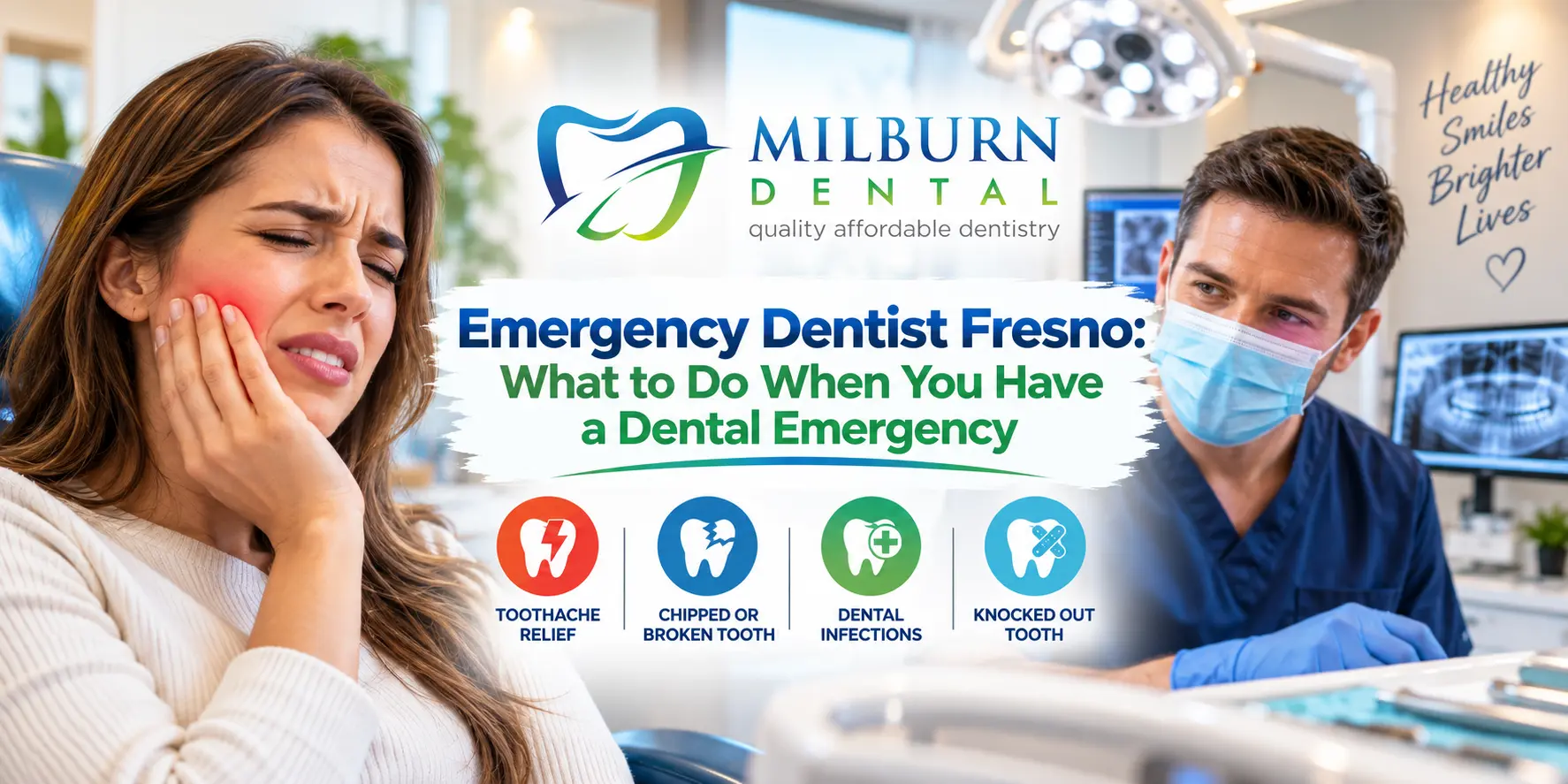
Dental emergencies can happen when you least expect them. A tooth may suddenly become extremely painful, a filling can fall out while you are eating, or an accident can leave you with a chipped, cracked, or knocked-out tooth. Knowing what to do and where to seek professional care can make a stressful situation easier to manage.
If you are searching for an emergency dentist in Fresno, it is important to find a dental office that can evaluate urgent problems and determine the appropriate treatment as quickly as possible.
Milburn Dental provides emergency dental care in Fresno, California, for problems including severe toothaches, broken or damaged teeth, dental infections, lost fillings, swelling, dental trauma, and other urgent dental concerns. The practice states that its dentists reserve time in their daily schedules for emergency patients and welcomes new patients and walk-ins.
Milburn Dental is located at 6721 N Milburn Avenue, Suite 101, Fresno, CA 93722, and can be reached at (559) 825-0990.
This guide explains what qualifies as a dental emergency, what you can do before seeing a dentist, and why prompt dental care can be important.
What Is a Dental Emergency?
A dental emergency is an oral health problem that requires prompt professional evaluation because of severe pain, infection, bleeding, trauma, or the possibility of additional damage.
Not every dental problem requires immediate treatment. However, symptoms that are severe, rapidly worsening, or associated with swelling or trauma should not be ignored.
Common dental emergencies include:
- Severe or persistent tooth pain
- A cracked or broken tooth
- A knocked-out permanent tooth
- A dental abscess
- Facial or gum swelling
- A lost filling
- A loose or lost crown
- Significant tooth sensitivity
- Bleeding following dental trauma
- A loose permanent tooth
- Pain when biting or chewing
- Injuries to the mouth or jaw
Milburn Dental specifically lists chipped or broken teeth, severe toothaches, lost fillings, abscessed teeth, hot or cold sensitivity, and other tooth or jaw emergencies among the situations for which patients should contact the office.
When Should You Search for an Emergency Dentist Fresno?
Many people are unsure whether their dental problem is serious enough to justify an urgent appointment.
A useful rule is to pay attention to the intensity and progression of your symptoms.
You should consider contacting an emergency dentist if you experience:
Severe Tooth Pain
A mild sensitivity that disappears quickly may not be an emergency.
Persistent or severe pain is different.
If tooth pain interferes with sleeping, eating, working, or normal daily activities, it deserves professional evaluation.
Severe pain can be associated with decay, inflammation, infection, trauma, or damage to the tooth.
Taking pain medication may temporarily reduce discomfort, but it does not necessarily address the underlying cause.
Swelling Around the Tooth or Face
Swelling around a tooth, gum, jaw, or face can be a sign of infection.
Dental infections can sometimes become more serious if they are not treated.
If you notice swelling along with severe pain, fever, a bad taste in your mouth, or a pimple-like bump on the gum, contact a dental professional promptly.
If swelling is affecting your ability to breathe or swallow, seek emergency medical care immediately.
Broken or Cracked Teeth
Teeth can crack or break because of accidents, sports injuries, grinding, biting hard foods, or other causes.
A small chip may not always require emergency treatment, but a painful or significantly damaged tooth should be evaluated.
The sooner the tooth is assessed, the sooner your dentist can determine whether it can be repaired or requires another form of treatment.
Milburn Dental recommends gently rinsing the mouth with warm water after a tooth breaks and using a cold compress if swelling is present.
What to Do If You Knock Out a Permanent Tooth
A knocked-out permanent tooth is a time-sensitive dental problem.
If an adult tooth has been completely knocked out, try to remain calm and handle the tooth carefully.
Hold the tooth by the crown, which is the portion normally visible in your mouth.
Avoid touching the root.
If the tooth is dirty, gently rinse it without scrubbing it or removing attached tissue.
If possible, you may carefully place the tooth back into its socket without forcing it.
If that is not possible, keep the tooth moist. Milburn Dental recommends keeping it in milk, between the cheek and gum, or in an appropriate tooth-preservation product.
Then contact an emergency dentist immediately.
Do not allow the tooth to dry out.
A knocked-out baby tooth should not be reinserted because doing so could potentially damage the developing permanent tooth. Contact a dental professional for appropriate instructions.
What to Do for a Cracked or Broken Tooth
A broken tooth can range from a minor chip to a significant fracture.
If you break a tooth:
- Rinse your mouth gently with warm water.
- Locate and save any pieces of the tooth.
- Apply a cold compress if there is swelling.
- Avoid chewing on the affected side.
- Contact an emergency dentist for an evaluation.
Do not attempt to glue a broken tooth back together yourself.
The appropriate treatment depends on the location and extent of the damage.
Depending on the situation, treatment may involve a filling, bonding, crown, root canal treatment, extraction, or another restorative procedure.
Severe Toothache: Is It an Emergency?
A toothache can have many possible causes.
Decay, a cracked tooth, inflammation, infection, gum problems, and trauma can all contribute to dental pain.
If the pain is mild and temporary, you may be able to schedule a regular appointment.
However, severe or persistent pain should be evaluated promptly.
Milburn Dental recommends contacting the office when a toothache becomes severe and emphasizes that delaying treatment may allow dental problems to become more serious.
While waiting for professional care, you can:
- Rinse your mouth gently with warm water.
- Carefully floss around the affected tooth.
- Avoid very hot or cold foods.
- Avoid chewing on the painful side.
- Use over-the-counter pain medication only as directed and when medically appropriate.
- Contact your dentist.
Do not place aspirin directly against your tooth or gum tissue. This can irritate or damage the soft tissue.
Dental Abscesses and Infections
A dental abscess is an accumulation of infection that can develop around a tooth or in the surrounding tissues.
Possible signs include:
- Severe tooth pain
- Swelling
- Tender gums
- A bad taste
- Pus
- Fever
- A pimple-like bump on the gums
- Pain when biting
An abscess should be professionally evaluated.
Do not attempt to puncture, squeeze, or drain it yourself.
A dentist can determine the source of the infection and recommend appropriate treatment.
Depending on the condition of the tooth, treatment may involve drainage, root canal therapy, extraction, antibiotics when clinically indicated, or another procedure.
If swelling extends into the face or neck or causes difficulty breathing or swallowing, seek emergency medical attention.
Lost Fillings
A filling can sometimes become loose or fall out.
When this happens, the affected tooth may become sensitive because part of the tooth is no longer protected.
If you lose a filling:
- Keep the area clean.
- Rinse gently with water.
- Avoid chewing on that side.
- Avoid very hot, cold, or sugary foods if the tooth is sensitive.
- Contact your dentist.
Milburn Dental provides Composite Fillings as part of its restorative dental services.
Your dentist can examine the tooth and determine whether it needs a replacement filling or another restoration.
Lost or Damaged Crowns
Crowns are designed to protect and restore damaged teeth, but they can occasionally become loose or fall out.
If your crown comes off, keep it in a safe place and contact your dental office.
Do not automatically attempt to permanently reattach it yourself.
The underlying tooth may be sensitive or vulnerable, particularly if it has previously undergone extensive restoration.
Milburn Dental provides Crowns and Bridges as part of its restorative dental services.
A dentist can determine whether the existing crown can be repaired or re-cemented or whether a replacement restoration is necessary.
Dental Trauma After an Accident
A fall, car accident, sports injury, or other impact can damage teeth and surrounding tissues.
Even when a tooth appears intact, trauma can sometimes affect the internal structures of the tooth.
After an accident, seek dental evaluation if you experience:
- Tooth pain
- A loose tooth
- Bleeding
- Swelling
- A chipped tooth
- A cracked tooth
- Changes in your bite
- Tooth sensitivity
- A tooth that has changed colour
If the accident also involves serious facial trauma, loss of consciousness, uncontrolled bleeding, or other potentially life-threatening injuries, seek emergency medical care first.
Emergency Dental Care for Sports Injuries
Sports-related dental injuries can happen to children, teenagers, and adults.
A properly fitted mouthguard can help protect the teeth during sports and recreational activities.
Milburn Dental recommends wearing a mouthguard during sports and recreational activities as one way to reduce the risk of dental injuries.
If a tooth is damaged during a game or practice, contact your dentist promptly.
A dental injury should not automatically be ignored simply because the pain seems manageable.
What Happens During an Emergency Dental Visit?
When you arrive for emergency dental care, the first step is generally to understand what happened and evaluate your symptoms.
Your dentist may ask:
- When did the problem begin?
- Did an accident occur?
- How severe is the pain?
- Is there swelling?
- Is the tooth sensitive?
- Is there bleeding?
- Have you taken any medication?
- Have you experienced similar problems before?
The dentist can then examine the affected area.
Depending on the situation, diagnostic imaging such as dental X-rays may be recommended.
Milburn Dental provides Dental X-Rays and explains that X-rays can help dentists evaluate areas that may not be visible during a standard visual examination.
Once the cause is identified, your dentist can discuss treatment options.
Why Dental X-Rays May Be Important During an Emergency
Some dental problems cannot be fully evaluated just by looking at the outside of the tooth.
An X-ray may help identify:
- Decay
- Bone changes
- Root problems
- Infection
- Damage below the gumline
- Problems associated with dental trauma
Milburn Dental uses digital X-rays as part of its dental diagnostic services.
The appropriate imaging depends on the symptoms and clinical situation.
Treatment Options for Dental Emergencies
There is no single treatment for every dental emergency.
The appropriate approach depends on the underlying problem.
Dental Fillings
A filling may be appropriate for certain cavities or damaged areas.
Milburn Dental provides tooth-coloured composite fillings as part of its restorative services.
Crowns
A crown may be considered when a tooth has significant structural damage and requires additional protection.
Root Canal Treatment
If the inner portion of a tooth is infected or severely inflamed, root canal treatment may be considered when the tooth can be preserved.
Tooth Extraction
In some cases, a tooth may be too damaged to restore predictably.
An extraction may then be recommended.
Milburn Dental provides Oral Surgery and Tooth Extraction services and notes that urgent dental problems such as severe pain, swelling, or trauma may require prompt evaluation.
Dental Implants
If a tooth must be removed, tooth replacement may be considered after the appropriate healing and treatment planning.
Milburn Dental offers Dental Implants as one option for replacing missing teeth.
Emergency Dental Care and Dental Anxiety
Dental emergencies are stressful enough without adding fear of dental treatment.
Some patients delay seeking care because they are anxious about pain, needles, dental procedures, or previous experiences.
Milburn Dental provides Comfort Aids and Sedation Dentistry and explains that comfort options may be considered for patients undergoing routine treatment or emergency procedures. The appropriate option depends on the patient’s health history and the recommended procedure.
If you are anxious, tell your dental team before treatment.
Useful information includes:
- Previous negative dental experiences
- Fear of needles
- Difficulty becoming numb
- Medication allergies
- Current medications
- Medical conditions
- Previous sedation experiences
Clear communication can help the dental team plan a more comfortable appointment.
Should You Go to a Hospital or an Emergency Dentist?
A dentist is generally the appropriate professional for a tooth-related problem.
However, some symptoms require emergency medical attention rather than waiting for a dental appointment.
Go to an emergency department or call emergency services if you experience:
- Difficulty breathing
- Difficulty swallowing
- Severe facial or neck swelling
- Uncontrolled bleeding
- Serious facial trauma
- Loss of consciousness
- Other potentially life-threatening symptoms
For a severe toothache, broken tooth, lost filling, dental abscess, or similar dental problem without life-threatening symptoms, contacting an emergency dentist can help you receive dental-specific evaluation and treatment.
What Should You Avoid During a Dental Emergency?
Knowing what not to do can be just as important.
Avoid:
Do Not Put Aspirin Directly on the Tooth
Aspirin should not be placed directly against the tooth or gums.
Do Not Use Sharp Objects
If something is stuck between your teeth, try gentle flossing.
Do not use knives, pins, needles, or other sharp instruments.
Do Not Ignore Severe Symptoms
If pain or swelling is worsening, contact a dental professional.
Do Not Chew on a Damaged Tooth
Chewing can potentially make a crack or fracture worse.
Do Not Attempt DIY Dental Repairs
Temporary home solutions may sometimes make the situation more difficult for your dentist to treat.
Professional evaluation is the safest way to determine what is happening.
How to Prevent Dental Emergencies
Not every emergency can be prevented, but several habits can reduce your risk.
Maintain Regular Dental Visits
Regular examinations can identify problems before they become emergencies.
Milburn Dental recommends routine dental examinations and cleanings every four to six months for many patients, with the appropriate frequency depending on individual needs.
You can learn more about Routine Dental Cleanings and preventive dental care.
Wear a Mouthguard
Use an appropriate mouthguard during contact sports and recreational activities.
Avoid Chewing Hard Objects
Milburn Dental recommends avoiding ice, popcorn kernels, and hard candy because these foods can contribute to cracked teeth.
Do Not Use Your Teeth as Tools
Never use your teeth to open packages, cut materials, or hold objects.
Use scissors or the appropriate tool instead.
Treat Small Problems Early
A loose filling, minor sensitivity, or damaged crown may seem insignificant.
Addressing these problems early can reduce the chance of a more serious problem developing.
Why Choose Milburn Dental for Emergency Dental Care in Fresno?
For patients searching for an emergency dentist Fresno, location and availability can be important when dealing with unexpected dental pain.
Milburn Dental is located at:
6721 N Milburn Avenue, Suite 101
Fresno, CA 93722
The office phone number is (559) 825-0990.
The practice states that it:
- Accepts new patients
- Welcomes dental emergencies
- Accepts walk-ins
- Reserves time for emergency patients
- Provides general and restorative dentistry
- Offers comfort options
- Provides digital X-rays
- Offers oral surgery and tooth extraction
- Provides dental implants and other restorative services
Milburn Dental describes itself as a family-oriented, full-service dental office serving Fresno and surrounding communities.
Emergency Dentist Fresno: When Should You Call?
If you are unsure whether your dental problem qualifies as an emergency, it is reasonable to contact a dental office and explain your symptoms.
Tell the dental team:
- What happened
- When it happened
- Where the pain is located
- How severe the pain is
- Whether there is swelling
- Whether there is bleeding
- Whether a tooth is broken or missing
- Whether you have a fever
- Whether you have difficulty swallowing or breathing
This information can help the dental team determine how urgently you should be evaluated.
Milburn Dental asks emergency patients to provide as much detail as possible when calling the office.
Frequently Asked Questions About Emergency Dentists in Fresno
What is considered a dental emergency?
Severe tooth pain, significant swelling, dental infections, knocked-out permanent teeth, broken or cracked teeth, uncontrolled dental bleeding, and certain dental injuries may require urgent professional attention.
Can I walk into Milburn Dental with a dental emergency?
Milburn Dental states that it accepts new patients and walk-ins for dental emergencies. Calling first at (559) 825-0990 allows the team to understand your situation and help determine the next step.
Does Milburn Dental reserve appointments for emergencies?
Yes. The practice states that its Fresno dentists reserve time in their daily schedules for emergency patients.
What should I do if my tooth is knocked out?
Handle the tooth by the crown, avoid touching the root, keep it moist, and contact a dentist immediately. If possible, carefully place a permanent tooth back into its socket without forcing it. If that is not possible, keep it in milk or an appropriate tooth-preservation solution.
What should I do if my tooth is cracked?
Rinse your mouth gently with warm water, save any pieces of the tooth, apply a cold compress if swelling is present, avoid chewing on the affected side, and contact a dentist promptly.
Is a dental abscess an emergency?
A dental abscess requires prompt dental evaluation. If swelling causes difficulty breathing or swallowing, seek emergency medical care immediately.
Can an emergency dentist treat a broken filling?
Yes. A dentist can examine the affected tooth and determine whether the filling can be replaced or whether another restoration is more appropriate.
Does Milburn Dental offer sedation or comfort options?
Milburn Dental provides comfort aids and sedation options for appropriate patients and procedures. The suitability of these options depends on your health history and treatment needs.
Where is Milburn Dental located?
Milburn Dental is located at 6721 N Milburn Avenue, Suite 101, Fresno, CA 93722. The office phone number is (559) 825-0990.
Contact an Emergency Dentist in Fresno
A dental emergency can be painful and stressful, but knowing what to do can help you respond quickly.
Severe tooth pain, swelling, infection, a broken tooth, a knocked-out permanent tooth, or significant dental trauma should not be ignored.
If you are searching for an emergency dentist Fresno, Milburn Dental provides urgent dental evaluations and treatment for a variety of dental emergencies. The practice states that emergency time is reserved in its schedule and that new patients and walk-ins are welcome.
Milburn Dental
6721 N Milburn Avenue, Suite 101
Fresno, CA 93722
Phone: (559) 825-0990
If you are experiencing a dental emergency, contact the office and explain your symptoms so the dental team can help determine the appropriate next step.